Comprehensive list of 2,211 phonograph-related patents issued in the United States between 1913 and 1919, organized by year, plus an index to patents issued from 1878 to 1919 organized by current classification.
An assortment of transcriptions and scanned illustrations put online back when such things were harder to find than they are now. Maintained as a legacy resource. |
|
 |
|
 Phonozoic.net is a legacy website that centers on projects launched before 2014. For other and more recent work, see the Griffonage-Dot-Com blog or this comprehensive list of articles, books, CDs, presentations, podcasts, radio interviews, and news items. Phonozoic.net is a legacy website that centers on projects launched before 2014. For other and more recent work, see the Griffonage-Dot-Com blog or this comprehensive list of articles, books, CDs, presentations, podcasts, radio interviews, and news items.
PDF Documents Hosted Here
- First Sounds PDF Publications Archive, including retired working papers no longer maintained at FirstSounds.org.
- “The Following Record”: Making Sense of Phonographic Performance, 1877-1908, Ph.D. dissertation, Indiana University Bloomington, 2007 [alternate link].
- Speech Acoustics and the Keyboard Telephone: Rethinking Edison’s Discovery of the Phonograph Principle, ARSC Journal 38:1 (Spring 2007): 10-43 [alternate link].
- “Perfectly Reproduced Slow or Fast”: A New Take on Edison’s First Playback of Sound, The Sound Box 29:1 (Mar. 2011): 3-7 [alternate link].
- “A Compass of Extraordinary Range”: The Forgotten Origins of Phonomanipulation, ARSC Journal 42:2 (Fall 2011): 163-203 [alternate link]).
- A Discography of Volta Laboratory Recordings at the National Museum of American History, January 2015 [alternate link].
- The Conventions of the Local Phonograph Companies, 1890-1893 (Sources in Phonographic History Series #1), Phonozoic, 2009 [alternate link].
- See also: Griffonage-Dot-Com Blog | Published Elsewhere | Google Scholar
Guest Contributions
Older content retired from the site can still be accessed through the Wayback Machine—see earlier versions of phonozoic.com (2001-2013), envy.nu/phonozoic (2001-2003), phonozoic.cjb.net (2001-2002), phonozoic.brinkster.net (2004-2019), and phonozoic.net (2005-present). Note in particular the reverse chronological list of past home page items (2007-2013); and the catalog of Phonozoic Records, a CD reissue label operated from 2000 through 2012. |
|
|
|
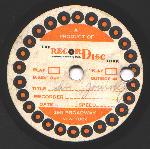
The goal of this project is to assemble an illustrated list of label types found on home recording discs of the mid-twentieth century. Not kept up lately, but judging from the correspondence I've received, people do find it useful.
The online presentation that, in 2009, introduced the world to the concept of "paleospectrophony," as well as the optical film sound track method of playing back phonautograms and such.
| |